
Why Should Someone Choose Your Business? Understanding Brand Positioning Strategy


Written by Dillon Kohler | Published October 14, 2026
What's in this article?
The 30-Minute Positioning Reset
Ask a business owner why someone should choose their company and the answer usually sounds pretty good: “We care about our customers,” “We deliver quality work,” “We create customized solutions.”
Positioning gets diluted slowly. One generic claim becomes three. One vague slogan gets copied across ads, proposals, and websites. Someone promises quality, someone else promises experience, and eventually every competitor in your industry sounds exactly the same.
When that happens, the default instinct is to add more: write a longer About Us page, invent a new tagline, lower prices, or run more ad spend. But often the smartest move is the exact opposite.
Stop. Take thirty minutes. Inspect your positioning system—and reset.
What a Brand Positioning Strategy Reset Is Actually For
A brand positioning strategy reset is not a 40-page strategy document. It is designed to help you find the single biggest reason customers hesitate to choose you—and fix it.
Differentiation is not a slogan exercise; it is a connected pipeline built into the entire buyer journey:
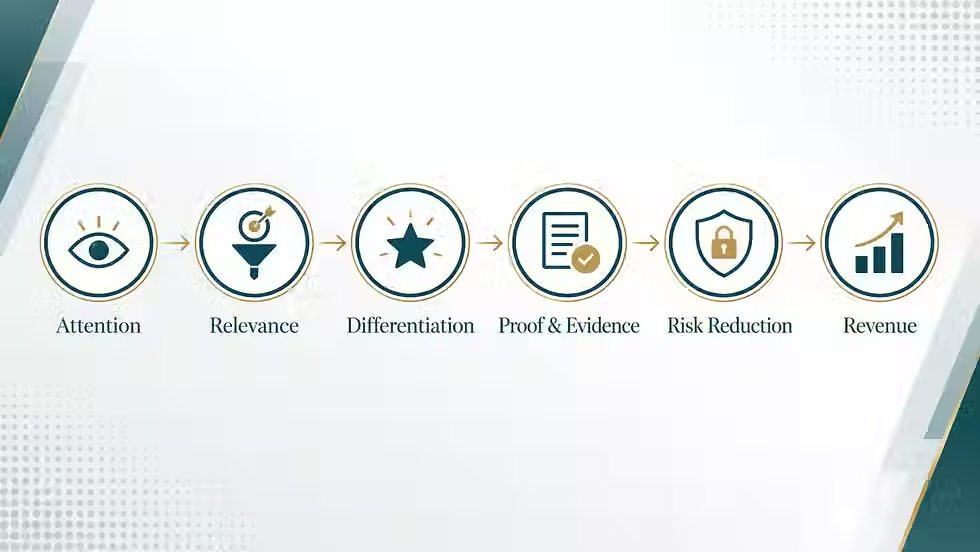
If any link in that pipeline breaks, another part of the business gets blamed. A positioning reset helps you isolate messaging friction before you throw more money at top-of-funnel traffic.
When to Run a Reset
Competitors could put their logo on your homepage headline and it would still make sense.
Sales calls require lengthy manual explanations of why your business costs more than cheaper alternatives.
Traffic is increasing, but qualified inquiries remain flat.
Core marketing claims rely on adjectives (“great service”) instead of verifiable mechanisms.
Your biggest lost deals aren’t going to direct competitors, but to “doing nothing” or “dealing with it later.”
The goal is to exit thirty minutes later with one clear differentiator, verifiable evidence, and immediate operational priorities.
Before You Start
Do not spend your time searching for assets. Before starting, open your primary conversion touchpoints:
Digital Assets: Homepage hero section, key landing pages, primary ad copy.
Sales Assets: Core proposal document, sales deck presentation, pricing sheets.
Customer Proof: Recent reviews, client testimonials, case studies.
If you cannot identify a clear, provable reason why a customer would choose you over direct or indirect alternatives, label it a Positioning Gap.
The Differentiation Audit Framework
Criteria | Diagnostic Question | Operational Standard |
Relevant | Does the ideal customer actually care about this difference? | Solves an urgent, specific pain point. |
Specific | Can a prospect easily understand what it means? | Uses concrete mechanisms, not adjectives. |
Distinct | Is it meaningfully different from market alternatives? | Fails the Competitor Logo Swap test. |
Provable | Can your business show hard evidence that claims are true? | Backed by data, reviews, or case studies. |
Operational | Does service delivery consistently fulfill the promise? | Aligned across operations and sales. |
Step-by-Step Reset Breakdown
Step 1: Run the Competitor Logo Test
Take the primary headline from your homepage or sales presentation. Remove your logo and replace it with your closest competitor's logo.
If “Helping Businesses Grow Through Innovative Solutions” still works for them, your messaging is doing zero differentiation. Write copy so specific that another company cannot use it without changing how they operate.
Step 2: Move From Generic Claims to Evidence
Stop relying on vague claims like "Exceptional Service" or "Fast Communication." Transform every claim using a 4-part framework:
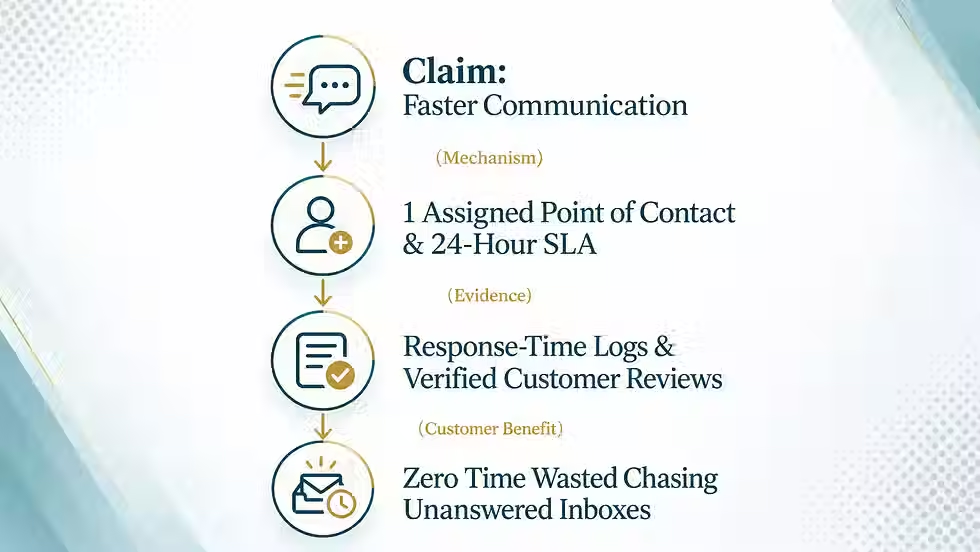
Step 3: Map Customer Alternatives Beyond Direct Competitors
Customers don't just compare you to direct rivals. They evaluate broader alternatives:
Doing it themselves
Hiring an internal employee
Using software or automation
Sticking with their current provider
Doing nothing (“We will deal with this later”)
Your marketing must first establish why the problem deserves action, and second why your approach is uniquely suited to solve it.
Step 4: Test Message & Offer Continuity
Inspect whether your prospect's journey remains coherent from first click to final onboarding:

When your positioning changes at every touchpoint, buyers get confused. Align your ads, website, sales proposals, and onboarding around one connected promise.
Step 5: Prioritize Your Positioning Fixes
Prioritize updates using an Impact-vs-Effort Matrix:
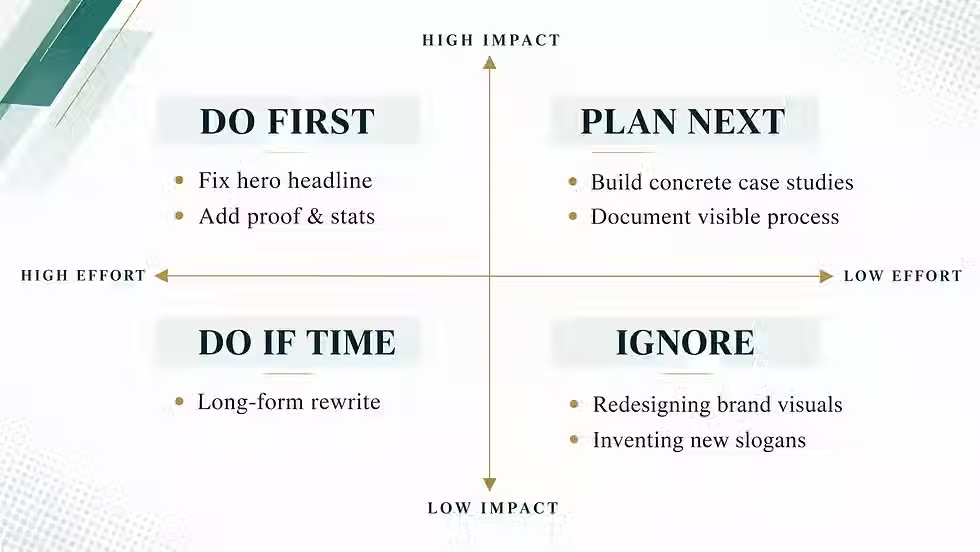
Select a maximum of three priorities and assign an Action, Owner, Deadline, and Metric to each:
Action: Replace generic homepage headline with concrete mechanism & customer outcome.
Owner: Head of Marketing.
Deadline: Friday by 5:00 PM.
Metric: Increase in qualified lead submission rate.
The 30-Day Positioning Rhythm
Structure your implementation across three horizons:
Immediate (Week 1): Eliminate cliché adjectives from homepage headlines, add specific SLAs/mechanisms to core service pages, and run sales deck text through the Logo Test.
30-Day Horizon: Publish 2–3 detailed case studies with clear context (Problem → Approach → Outcome), document your operational process visually, and mine customer reviews for exact buyer language.
90-Day Horizon: Align client onboarding and customer service SLAs directly with marketing claims, establish a lost-deal feedback log, and unify CRM outreach messaging.
Stop Scaling Bland Positioning
If your positioning is generic, driving more traffic simply multiplies confused visitors. If your value proposition is vague, increasing your ad budget simply scales wasted spend.
Saying you are different is easy. Giving the right customer a clear, believable reason to choose you is strategy. Inspect the pipeline, define your real differentiator, and verify the performance lift before scaling your marketing.
Ready to Define Your Real Differentiator?
You don't need another generic slogan or a bigger ad budget, you need a clear, believable positioning strategy that turns market attention into revenue.
At House of Strategies, we help service businesses connect their messaging, customer journey, and operations to give ideal clients an unmistakable reason to choose them.

Dillon Kohler
Dillon Kohler helps service businesses strengthen their positioning, clarify their messaging, and build marketing strategies designed to turn attention into meaningful growth. Through House of Strategies, he focuses on connecting brand strategy, customer journeys, and marketing execution so businesses can communicate their value more clearly, differentiate themselves in competitive markets, and create a stronger path from visibility to revenue.


Comments