
What Makes Your Business Credible?


Written by Dillon Kohler | Published October 21, 2026
What's in this article?
Before someone becomes your customer, they make a decision you may never hear them say out loud: "Do I actually believe this business?"
They might like your website. They might be impressed by your social media content. They might even think your services are exactly what they need. But that doesn't automatically mean they're ready to hand over their money.
So, they start looking for reassurance. They check your reviews. They visit your About page. They search your business name. They look at your team, your past work, and the promises you are making.
Sometimes, they don't find anything particularly concerning. They just don't find enough to feel confident.
That is an important distinction. A business doesn't have to look dishonest to lose a potential customer—it might simply fail to demonstrate why it deserves to be trusted.
This is where credibility becomes a critical part of marketing. You can spend thousands of dollars getting people to notice your business, but if those people question your legitimacy or ability to deliver, that attention will never turn into revenue.
At House of Strategies, we view credibility as something much bigger than a five-star review or a professional-looking website. It is the alignment between what your business promises, what it can prove, and what customers actually experience.
Credibility Is Not the Same as Visibility
Businesses often confuse being recognized with being credible. They are not the same thing.
Visibility means people know your business exists.
Credibility means people have a reason to believe what your business says.
Trust means they feel confident enough to rely on you.
Imagine two accounting firms. Firm A has a large social media following, runs constant ads, and posts daily. Firm B has a smaller audience but clearly explains its services, introduces its CPAs, provides verifiable credentials, and features detailed case studies from actual clients.
Which firm would you trust to handle a complicated financial audit?
Attention gets you considered. Credibility helps you get chosen. The more expensive or consequential the purchasing decision, the more important that distinction becomes.
1. Clear Communication Makes Your Business More Believable
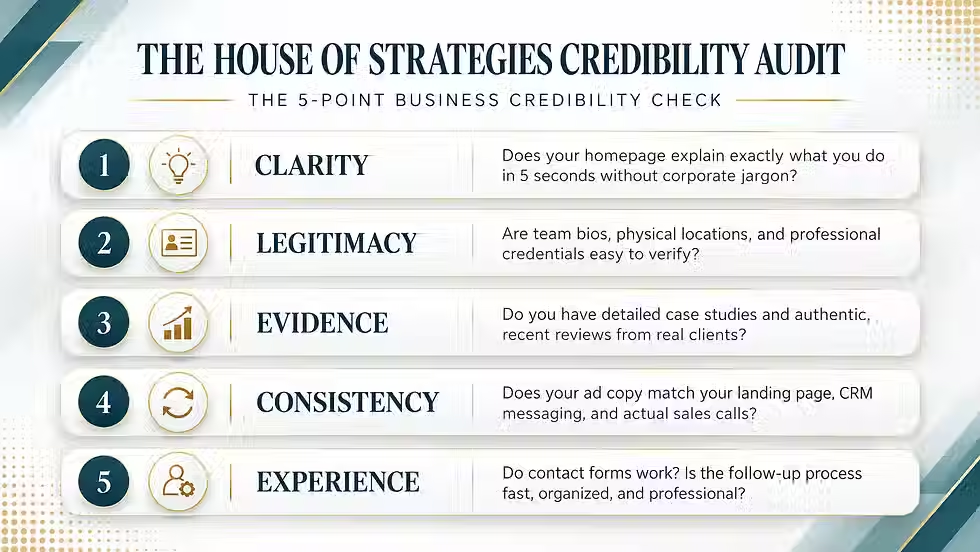
One of the most overlooked elements of credibility is clarity. A potential customer should be able to understand what your business does without needing to decode corporate jargon.
Many websites are filled with statements like: "We provide innovative, results-driven solutions that empower businesses to achieve their full potential."
That might sound professional, but what does the company actually do? Who is it helping? What happens if someone hires them?
Specificity Makes Claims Easier to Evaluate
Imagine a web design company using this headline: "We Build Websites That Grow Your Business."
Now imagine the same company explaining: "We build service-business websites designed to turn visitors into inquiries, with mobile-friendly pages, clear calls-to-action, and tracking for forms and phone calls."
The second statement gives the reader something concrete to evaluate. It doesn't guarantee success—it simply communicates a more understandable proposition. A claim asks someone to believe you; evidence gives them a reason to.
2. Show That Real People Stand Behind the Business
A website without recognizable people, meaningful company information, or clear contact methods feels impersonal. Potential customers want to understand who they are dealing with—especially when handing over financial data or entering a long-term contract.
A credible business profile should include:
The owner's professional background and experience.
Authentic photographs of the people providing the service (avoid generic stock photos).
Professional licenses, certifications, or verifiable memberships.
A clear explanation of where the business operates.
An About Page shouldn't just tell visitors how your business began in 2015. It should explain why your team is equipped to solve their specific problem today.
3. Customer Reviews Are Powerful (When Handled Correctly)
You can tell potential customers your service is excellent, but they will place far greater weight on an actual customer's experience.
However, not all reviews communicate the same value:
Generic Review: "Great company! Highly recommend!"
Detailed Review: "We hired this team to redesign our website. They explained the timeline upfront, communicated clearly, and trained our staff on how to manage the new site after launch."
The second review offers actionable information. It describes the service and identifies specific qualities a future buyer cares about.
⚠️ Compliance Note: Never manufacture credibility. The FTC's Consumer Reviews and Testimonials Rule (effective October 2024) prohibits deceptive practices, including fake reviews, review suppression, and purchasing reviews conditioned on positive sentiment. A fabricated testimonial can do substantially more damage to your reputation than having a smaller number of authentic reviews.
4. Demonstrate Your Expertise Instead of Announcing It
Almost every professional service business claims to be an "industry leader." Expertise becomes credible only when people can see how you think.
This is where educational marketing becomes valuable:
An attorney explaining common mistakes in business formation.
A CPA explaining the difference between tax planning and tax preparation.
A marketing professional explaining how to track Cost of Acquisition (CAC).
Providing useful information before asking for a sale gives prospects the opportunity to evaluate your competence.
Google's E-E-A-T Framework: Google's search quality guidelines emphasize Experience, Expertise, Authoritativeness, and Trustworthiness. While not a direct ranking formula, the principle remains: content should demonstrate genuine understanding and offer real utility to the reader.
5. Case Studies Show What You Can Actually Accomplish
While reviews describe experiences, case studies explain a problem, the work performed, and the outcome.
The strongest case studies don't need exaggerated promises or massive ROI claims. Their credibility comes from being specific and appropriately qualified. A strong case study structure includes:
The Problem: What was preventing the customer from reaching their goal?
The Starting Point: What was happening before the engagement?
The Strategy: What did your business recommend, and why?
The Execution: What was actually implemented?
The Outcome: What changed, and how was that change measured?
6. Transparency Reduces the Uncertainty of Buying
Many businesses hide their pricing, timelines, or limitations, believing that withholding information will force prospects to call them.
Think about the customer's perspective. When businesses fail to address basic questions ("How much does this cost?" "What happens after I submit this form?"), potential customers are left to guess. Uncertainty is a primary reason people delay a purchase.
Transparency does not mean publishing a rigid price list for custom consulting. It means explaining how your pricing works, what factors influence the cost, and what the engagement timeline looks like.
7. Your Sales Follow-Up Communicates How You Operate
Many businesses assume credibility-building ends when a lead form is submitted. In reality, that is when your promises are tested most directly.
If a company advertises "exceptional attention to detail," but a prospect submits an inquiry and hears nothing for four days, credibility vanishes.
A thoughtful sales process demonstrates competence:
Acknowledging that the inquiry was received immediately.
Explaining expected response times.
Using information the prospect already provided in the form.
Providing clear proposals that match what was discussed.
When a business says it is organized and professional, its follow-up process must make those qualities visible.
How Do You Measure Whether Credibility Is Improving?
Credibility is not a single metric on a dashboard, but its impact is measurable. Look for these behavioral shifts:
Website Conversion Rate: Are more relevant visitors booking consultations?
Qualified Lead Rate: Are the people contacting you better aligned with your pricing and services?
Sales Friction: Are prospects spending less time questioning your qualifications or negotiating price?
Referral Velocity: Are existing clients actively sending new business your way?
If prospects repeatedly ask what your firm actually does during sales calls, your website lacks clarity. If they disappear after receiving a proposal, your sales process or pricing transparency needs work.
Credibility Is a Business Strategy, Not a Marketing Tactic
A credible business isn't necessarily the company with the most followers or the largest advertising budget. It is a company that gives people meaningful reasons to believe what it says.
At House of Strategies, we do not believe individual marketing channels should be evaluated in isolation. Your website, ad copy, educational content, CRM, and sales follow-up all influence how people experience your business. When those elements contradict each other, the customer is left trying to decide which version of the company to believe.
Credibility-building isn't just about adding trust badges to your homepage. It is about aligning what you promise with what you actually deliver.
Does Your Marketing Match Your Expertise?
You can spend thousands on advertising, but if your funnel lacks credibility, traffic will never turn into revenue. Partner with House of Strategies to audit your brand positioning, align your sales systems, and build a marketing engine your customers actually trust.

Dillon Kohler
Dillon Kohler helps service businesses strengthen their positioning, clarify their messaging, and build marketing strategies designed to turn attention into meaningful growth. Through House of Strategies, he focuses on connecting brand strategy, customer journeys, and marketing execution so businesses can communicate their value more clearly, differentiate themselves in competitive markets, and create a stronger path from visibility to revenue.


Comments